
Payment Flows with Stripe Elements & Serverless AWS Architecture
Secure, brand-consistent checkout with Stripe Elements and a serverless AWS backend
Executive Summary
This project focused on integrating a secure, fully customizable payment flow into a modern React web application. By leveraging Stripe Embedded Checkout Elements alongside a serverless AWS backend built with AppSync and TypeScript, the team eliminated the need for traditional payment servers.
The result is a seamless, brand-consistent checkout experience that offloads PCI compliance to Stripe while maintaining a scalable, event-driven backend architecture.
The Challenge
Integrating payments often forces teams to balance security, user experience, and infrastructure complexity.
Security & Compliance
Handling card data directly introduces significant PCI compliance overhead and increases security risk.
User Experience
Redirecting users to third-party hosted checkout pages can disrupt the flow, reduce trust, and lower conversion rates.
Infrastructure Constraints
Traditional payment servers require:
- Continuous uptime
- Scaling management
- Ongoing maintenance
This conflicts with modern serverless-first strategies.
Objective:
Deliver a native-feel checkout embedded directly in the application that is
secure, scalable, and fully typed with TypeScript.
The Solution: Headless & Serverless Payments
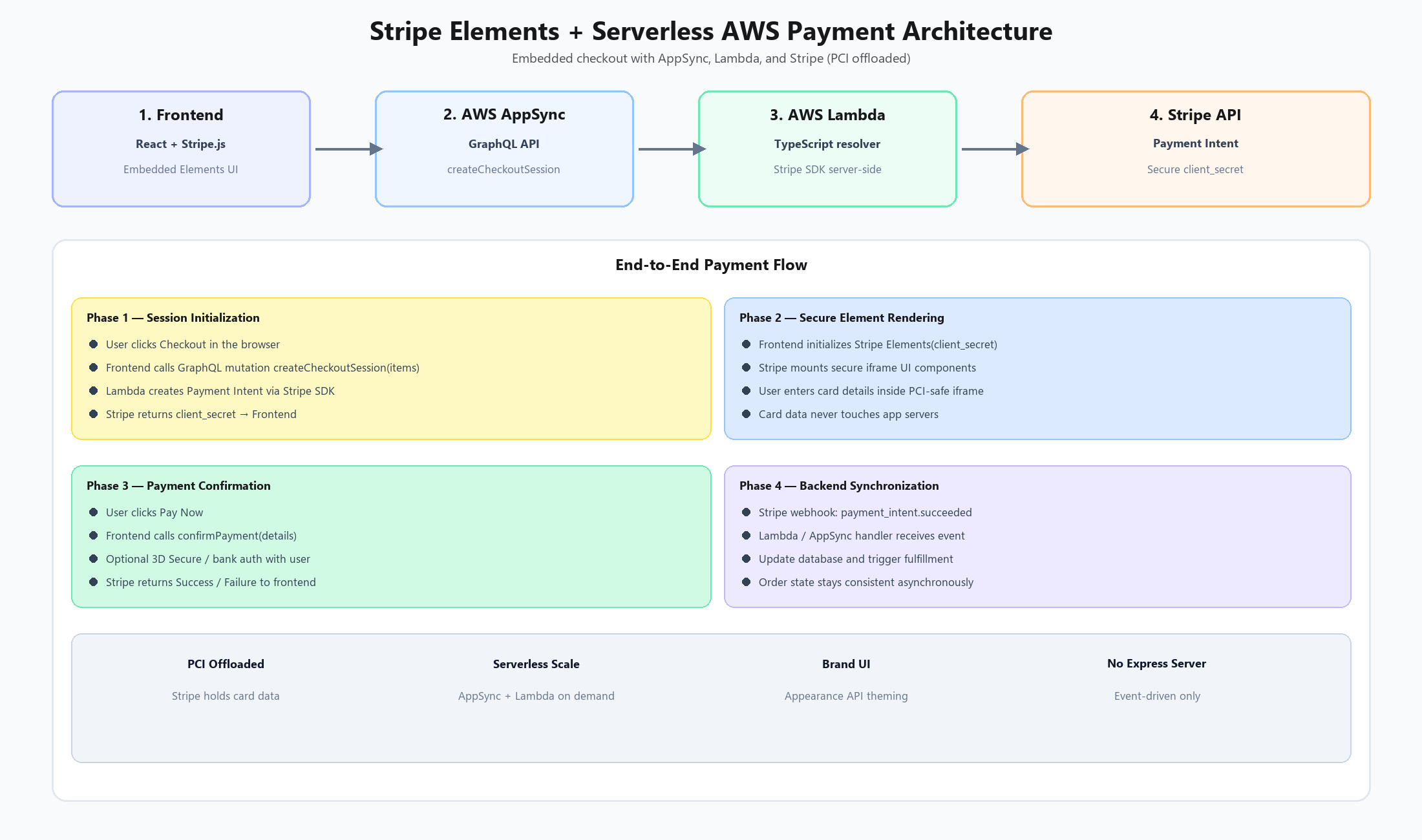
The team implemented a headless, event-driven payment architecture.
Technology Stack
- Frontend: React with
@stripe/react-stripe-js - Backend: AWS AppSync (GraphQL) + AWS Lambda (Node.js / TypeScript)
- Payments: Stripe Embedded Checkout (Custom UI mode)
Key Architectural Shift
Instead of a long-running Express server, the system operates entirely on events:
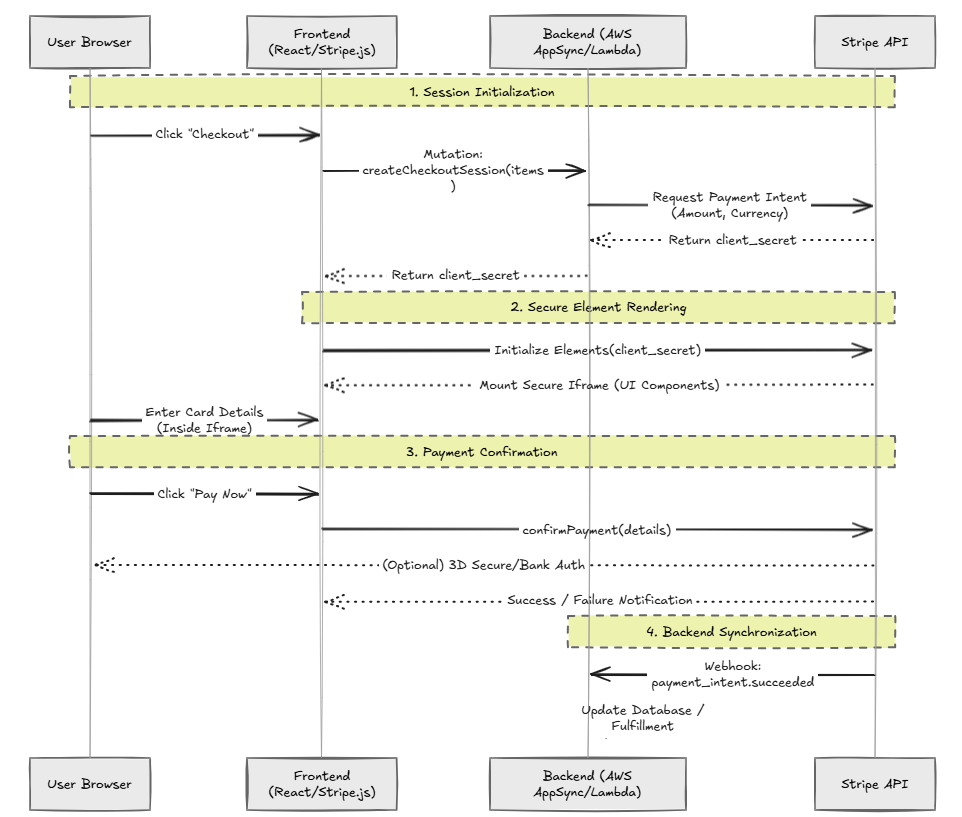
- Client requests a checkout session via GraphQL
- AppSync routes the request to a Lambda resolver
- Lambda communicates with Stripe to generate a secure
client_secret - Client initializes Stripe Elements using the returned secret
This approach ensures security, scalability, and cost efficiency.
Implementation Details
Phase 1: Server-Side Logic (AWS AppSync & Lambda)
The backend was designed to be lean, strongly typed, and purpose-built.
- A GraphQL mutation
createCheckoutSessionaccepts a payment amount - A TypeScript Lambda resolver initializes the Stripe SDK, creates a checkout session with
ui_mode: 'custom', and returns a secureclientSecretto the client
This keeps all sensitive payment logic securely on the server.
Phase 2: Client-Side Integration (React)
The frontend implementation prioritized performance and reliability:
- Stripe Initialization: The Stripe instance is loaded asynchronously using
loadStripeoutside the component tree to avoid unnecessary reloads - Provider Pattern: A
CheckoutProviderwaits for theclientSecretbefore rendering the payment form, ensuring the secure context is always ready - Payment Element: The
PaymentElementdynamically renders the correct input fields (card number, expiry, CVC) based on the session configuration
Phase 3: Brand Consistency with Stripe Appearance API
To avoid a generic checkout appearance, the Stripe Appearance API was applied:
- Flat, modern theme
- Custom brand variables such as
colorPrimary: '#0570de'andborderRadius: '8px'
This made Stripe Elements visually indistinguishable from native application UI components.
Results & Benefits
The new payment architecture delivered measurable benefits across multiple areas.
Key Outcomes
- Enhanced Security: Card data never touches application servers; Stripe fully handles PCI compliance
- Automatic Scalability: AWS AppSync and Lambda scale instantly during traffic spikes and sales events
- Improved User Experience: Users remain on-site throughout checkout, improving trust and conversion rates
- Developer Efficiency: End-to-end TypeScript usage reduced runtime errors and improved development speed
Conclusion
By decoupling the payment experience from traditional backend infrastructure, this solution delivers the best of both worlds:
- The security and compliance of a hosted payment provider
- The flexibility and branding of a custom checkout
- The scalability and cost efficiency of serverless AWS services
This architecture provides a future-proof foundation for modern, high-conversion payment experiences.
Ready to Transform Your Business?
Let's discuss how our AI and software solutions can drive your success.