Building a Serverless Media Processing Pipeline on AWS
Serverless media pipeline from upload to HLS/WebP with adaptive streaming and cost efficiency
Introduction
In today’s digital landscape, media processing is no longer just a backend concern - it is a core part of user experience. Users expect instant uploads, fast playback, and consistent quality across devices and network conditions. At the same time, platforms must manage storage growth and CDN costs at scale.
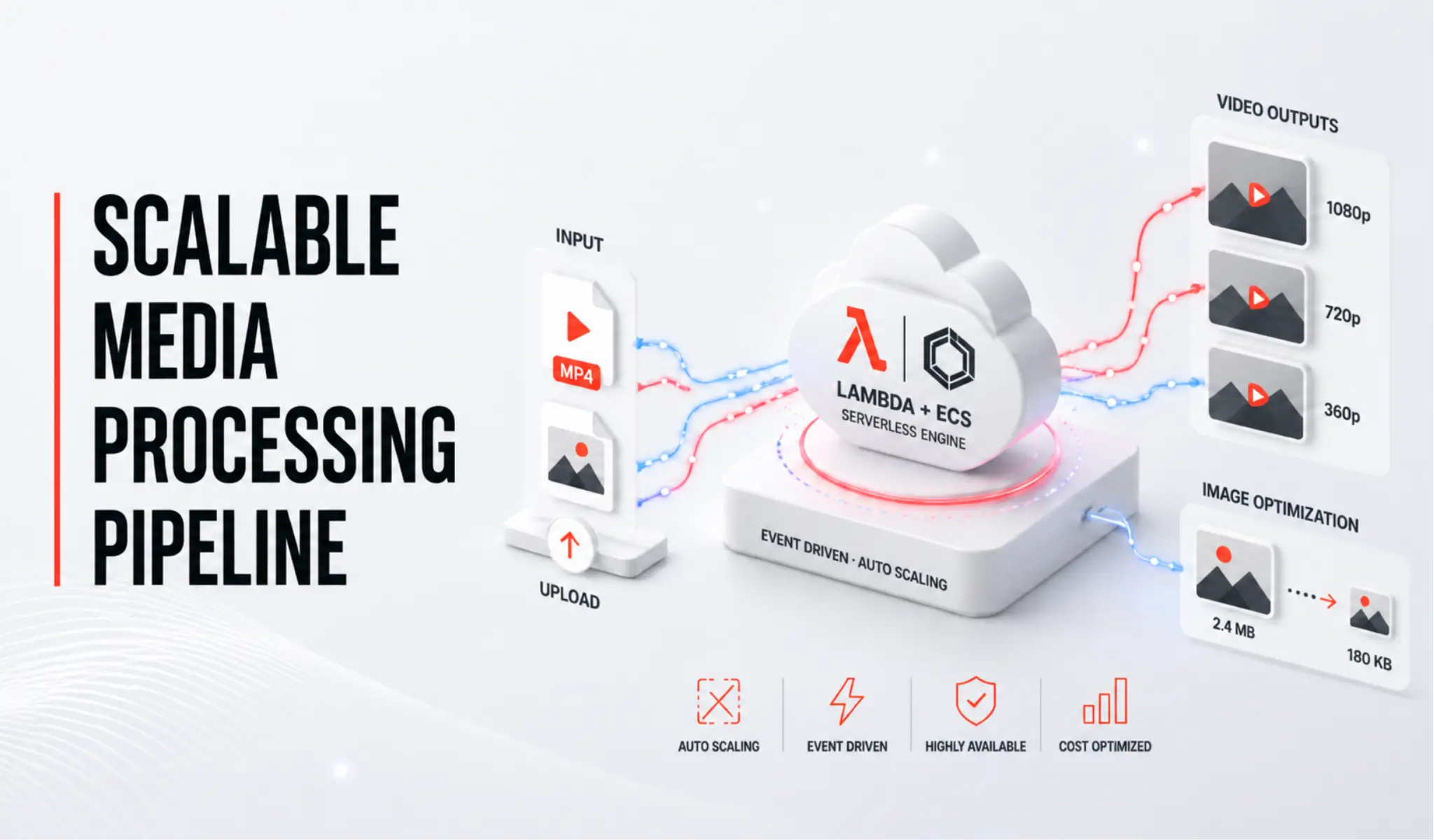
This case study explores a production-ready, event-driven media processing pipeline on AWS. By adopting a serverless-first architecture, raw uploads are automatically converted into adaptive HLS video streams and highly optimized WebP images, all without manual infrastructure management.
The Challenge

Modern media platforms face a difficult balance between performance, scalability, and cost. High-resolution content improves visual quality but introduces buffering, storage overhead, and increased bandwidth usage.
Key Requirements
- Video Versatility: Support MP4, MOV, and MKV formats ranging from 10MB to several gigabytes
- Adaptive Streaming: Deliver HLS streams at 1080p, 720p, and 360p
- Aggressive Image Optimization: Achieve 95%+ file size reduction with minimal quality loss
- Operational Efficiency: Eliminate server management and pay only for actual processing time
Architectural Philosophy
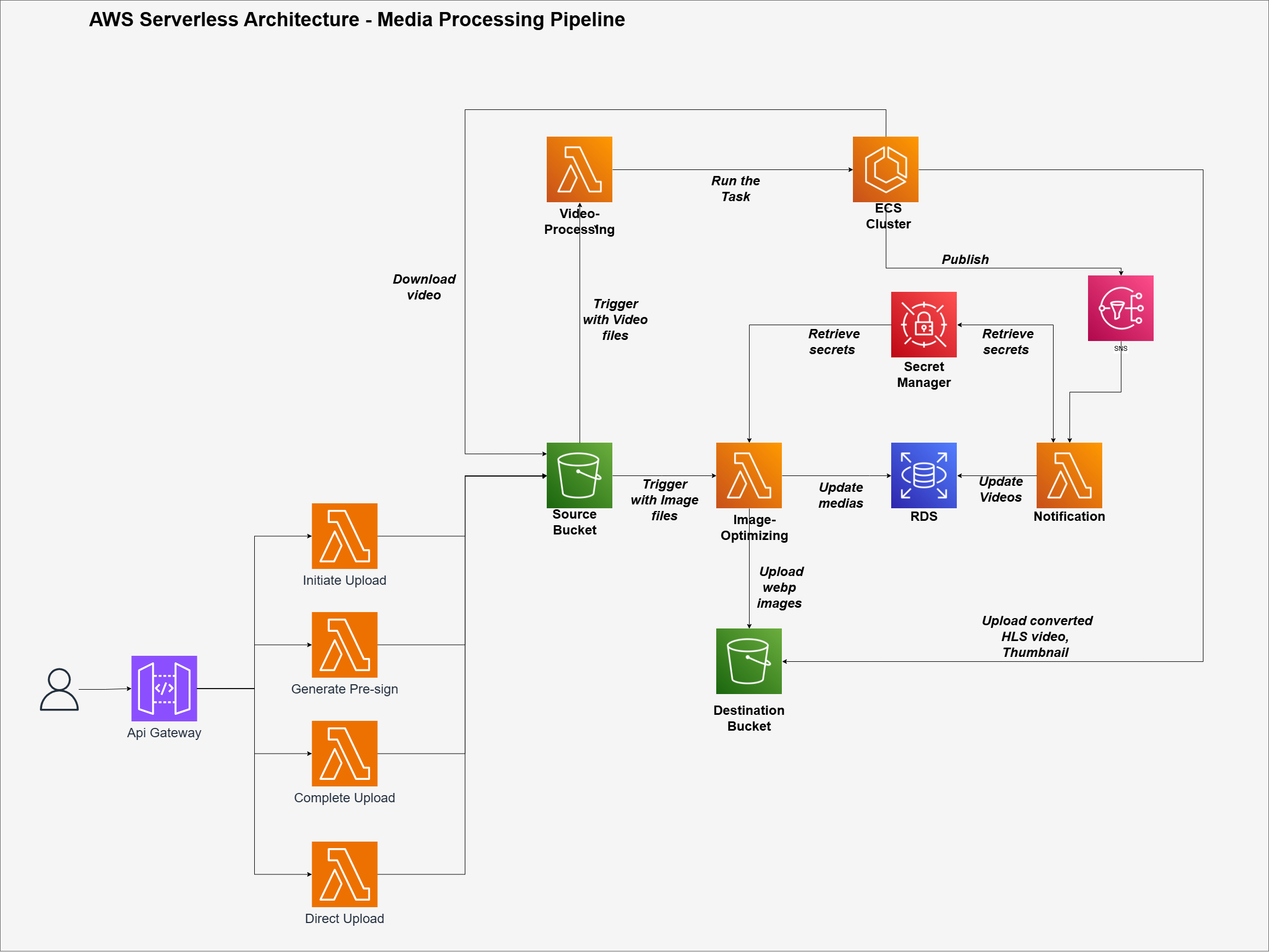
The system is built on an event-driven architecture where Amazon S3 upload events automatically trigger processing workflows. This removes the need for polling or manual intervention and ensures compute resources are consumed only when content is uploaded.
Key principles include:
- Serverless-first design using AWS-managed services
- Loose coupling between upload, processing, and delivery
- Automatic scaling from zero to peak traffic without capacity planning
Intelligent Upload Strategy
To optimize the first mile of content delivery, the platform uses a dual upload strategy based on a 25MB file size threshold.
Upload Modes
Direct Upload (< 25MB)
- S3 presigned URLs with transfer acceleration
- Single HTTP PUT request
- A 20MB file uploads in seconds
Multipart Upload (≥ 25MB)
- Files split into 5–10MB chunks
- Parallel uploads with per-part retries
- Reduces a 100MB upload from ~3 minutes to under 30 seconds
Video Processing Pipeline (HLS & ECS Fargate)
Workflow Overview
- A video is uploaded to the source S3 bucket
- An S3 event triggers a Video Processing Lambda
- The Lambda orchestrates an ECS Fargate task
- FFmpeg performs multi-bitrate video processing
- Output is delivered globally via CloudFront
Why ECS Fargate?
- Video processing can exceed Lambda’s 15-minute timeout
- Provides unlimited runtime with dedicated 2 vCPUs and 4GB RAM
- Automatically scales and charges only for task duration
HLS Conversion Process
The FFmpeg-based workflow performs:
- Metadata extraction using FFprobe
- Orientation-aware resolutions
- Landscape: 1080p, 720p, 360p
- Portrait: 1080×1920, 720×1280, 360×640
- Thumbnail generation
- High-quality JPEG
- 2-second animated GIF
- Audio normalization
- Adds silent audio when missing for browser compatibility
- Multi-bitrate HLS encoding
- H.264 codec
- 6-second segments per resolution
- Master playlist creation
- Enables adaptive quality switching
Processing Time:
A 20MB video completes in approximately 2 minutes, producing three adaptive quality levels plus thumbnails.
Image Processing Pipeline (Sharp & WebP)
Sharp Lambda Layer Architecture
Image uploads trigger a lightweight Lambda function powered by Sharp, a high-performance image processing library built on libvips.
- Packaged as a custom Lambda layer
- Compiled for Amazon Linux (Lambda runtime)
- Keeps deployment packages small and efficient
Optimization Workflow
- Download original image from S3
- Detect and convert HEIC/HEIF images if required
- Convert to WebP (85% quality)
- Extract metadata and compression statistics
- Upload optimized image to destination bucket
- Update database with retry and exponential backoff
Processing Time: Images complete in under 3 seconds.
Real-World Example
- Original JPEG: 1.82 MB
- Optimized WebP: 42 KB
- 97.7% size reduction with visually identical quality
Results & Impact
Scalability
- 1,000+ videos and 5,000+ images processed daily
- Automatic scaling to 100+ concurrent ECS tasks
- Zero infrastructure management
Performance
- Video processing:
- ~2 minutes for 20MB files
- 4–5 minutes for 100MB files
- Image processing: 2–3 seconds average
- Playback: Instant start with adaptive quality switching
Cost Savings
- 95–98% image size reduction
- 90% CDN bandwidth savings
- Faster page loads and improved SEO
Key Technical Lessons
- Lambda vs ECS: Lambda for orchestration and lightweight tasks, ECS Fargate for long-running FFmpeg workloads
- HLS over MP4: Adaptive streaming eliminates buffering on slow networks
- WebP Adoption: Modern browser support makes WebP the ideal format
- Lambda Layers: Native binaries deliver high performance without external services
Conclusion
This project demonstrates how serverless architectures can power complex, compute-intensive media workflows with minimal operational overhead. By combining AWS Lambda, ECS Fargate, S3, and CloudFront, the platform scales automatically, costs pennies per upload, and delivers a smooth, high-quality media experience.
The result is a future-proof media pipeline that balances performance, scalability, and cost efficiency - without managing servers.
Ready to Transform Your Business?
Let's discuss how our AI and software solutions can drive your success.