
Building a Scalable Batch Processing Platform on AWS
Event-driven serverless batch processing on AWS for millions of records with full visibility
Executive Summary
Processing massive volumes of data reliably and at scale is no longer optional in today’s data-driven world.
This case study explores a serverless batch processing platform on AWS, capable of handling millions of records from large text files while maintaining reliability, visibility, and operational simplicity.
The Challenge
The system needed to:
- Ingest large text files uploaded by users
- Process each record independently
- Provide real-time insight into job progress and failures
Constraints and pain points included:
- Files containing millions of lines
- Partial failures allowed but must not block the batch
- Traditional batch systems struggled with scalability, long-running processes, and operational overhead
The solution had to scale instantly, fail gracefully, and recover automatically without constant infrastructure management.
The Approach: Event-Driven Serverless Architecture
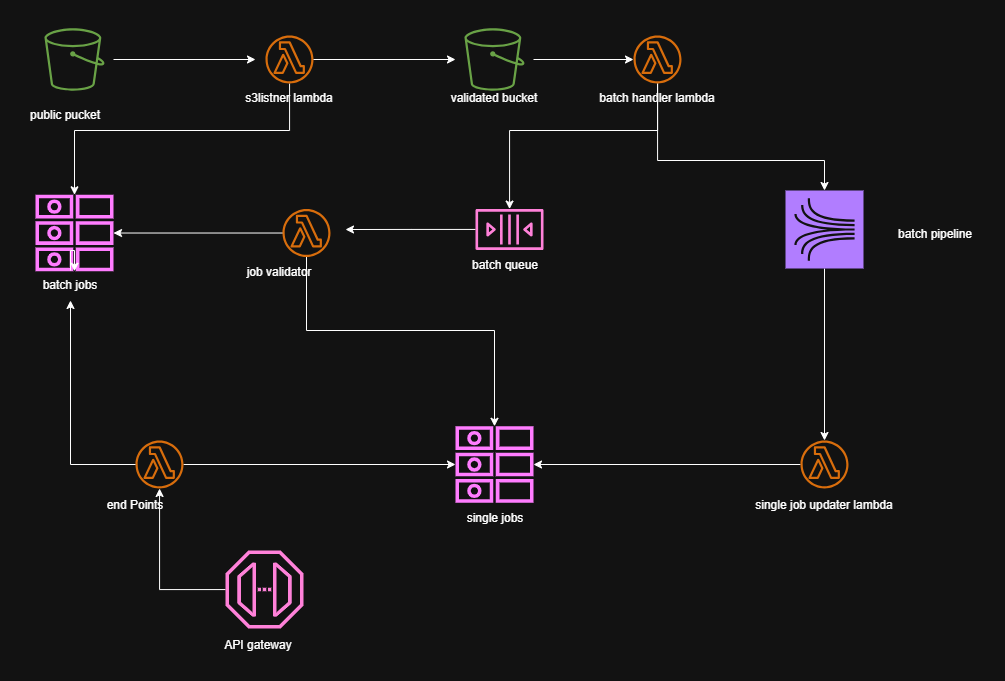
We adopted a fully serverless architecture on AWS with managed services:
- S3: File storage and ingestion events
- Lambda: File validation and record-level processing
- DynamoDB: Job and record metadata persistence
- Kinesis: Real-time record streaming
- SQS: Batch-level progress monitoring
Key design principles:
- Clear separation between file validation, record processing, job monitoring, and user APIs
- High parallelism for record-level processing
- Fault isolation to ensure failures don’t block the batch
How the System Works
1. File Ingestion & Validation
- Users upload files to an S3 bucket
- Lambda validates files, renames them, and moves to success/error folders
- A batch job entry is created in DynamoDB
- Invalid files are blocked early, preventing downstream issues
2. Streaming & Batch Scheduling
- Files processed line by line using Node.js streaming
- Records pushed to Kinesis for real-time processing
- Batch metadata sent to SQS for delayed job monitoring
3. Record-Level Processing
- Kinesis-triggered Lambda processes each record independently
- Downstream services invoked per record
- Results persisted in DynamoDB
- Failures isolated to individual records
4. Monitoring, Retries & Completion
- SQS-triggered Lambda monitors job progress
- Controlled retry with backoff for failed records
- Batch marked complete when all records succeed or reach retry limits
5. Job Visibility & APIs
- API Gateway + Lambda provide users with:
- Batch job status
- Record-level progress
- No direct access to internal logs required
Key Challenges
- Designing DynamoDB access patterns to avoid hot partitions
- Managing Kinesis throughput under high load
- Operating within Lambda concurrency and API limits
- Implementing idempotent retries to avoid duplicate processing
Results
The system delivered:
- Reliable processing of millions of records per batch
- Automatic scaling with no infrastructure management
- Fault isolation at the record level
- Controlled retries with backoff
- Clear visibility into batch and record-level status
The platform proved stable, cost-efficient, and adaptable to evolving data needs.
Key Takeaways
- Event-driven, serverless architectures are highly effective for large-scale batch workloads
- Combining managed cloud services, careful data modeling, and streaming techniques enables:
- Effortless scaling
- High reliability under load
- Operational simplicity
Ready to Transform Your Business?
Let's discuss how our AI and software solutions can drive your success.