
Recommendation Engine for Personalized Content Experiences
Real-time personalization with scalable recommendation systems that balance relevance and privacy
Introduction
Personalization is no longer optional - users expect relevant content the moment they open an app. Delivering the right content at the right time is critical to user satisfaction, engagement, and long-term retention.
This case study explores a next-generation video recommendation engine that uses advanced machine learning to deliver real-time, personalized, and diverse recommendations at scale. The system is designed with strict performance targets, privacy guarantees, and cost efficiency at its core.
Why Recommendation Engines Matter
A well-designed recommendation engine directly impacts both user experience and business outcomes.
Key Benefits
- Keep users engaged: Longer sessions and higher content consumption
- Increase retention: Relevant recommendations drive repeat visits
- Encourage discovery: Promote new content and reduce recommendation fatigue
- Scale efficiently: Millions of recommendations per day with <100ms latency
- Reduce costs: Intelligent caching lowers computational overhead
How the Recommendation Engine Works
The engine follows a layered, production-grade architecture that separates concerns across retrieval, ranking, and optimization stages. This design ensures high relevance, low latency, and predictable scalability under heavy traffic.
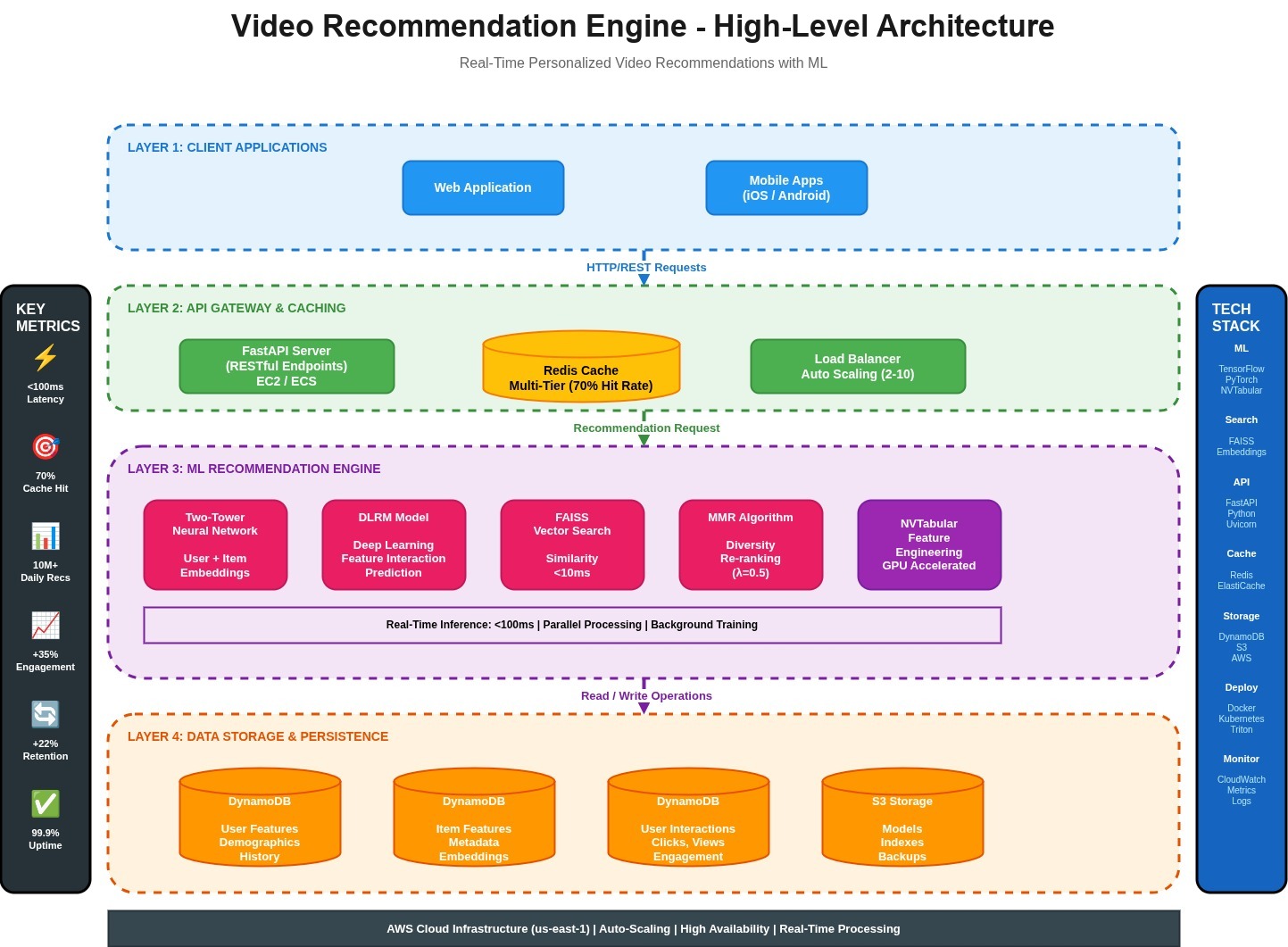
Core Design Principles
- Separation of retrieval and ranking for scalability
- Hybrid modeling to avoid dependency on a single signal
- Low-latency inference for real-time personalization
- Diversity-aware ranking to prevent content fatigue
Hybrid Recommendation Approach
A single recommendation strategy is rarely sufficient at scale. The system combines multiple signals into a hybrid recommendation model.
Signal Types
- Collaborative Filtering: Learns implicit preferences from similar users using watch time, completion rates, and likes
- Content-Based Filtering: Leverages video metadata and semantic embeddings to match content to user interests
- Popularity & Quality Signals: Ensures trending and high-quality content is always eligible
By dynamically weighting these signals, the engine adapts to both new users and power users, effectively solving cold-start scenarios while maintaining high accuracy.
Two-Tower Neural Network

The Two-Tower model forms the backbone of large-scale candidate generation.
Architecture Overview
- User Tower: Demographics, viewing history, engagement intensity, and category preferences
- Item Tower: Video metadata, creator signals, semantic embeddings, and popularity trends
Why Two-Tower?
- Independent user and item embeddings
- Item embeddings are pre-computed and cached
- Enables fast similarity matching at scale
This architecture supports millions of users and videos while maintaining ultra-low latency during inference.
Deep Learning Recommendation Model (DLRM)
While the Two-Tower model excels at retrieval, DLRM provides precision ranking.
What DLRM Does
- Combines dense features (watch time, engagement score, and recency)
- Embeds sparse categorical features (genres, device type, and region)
- Explicitly models feature interactions
- Outputs a predicted engagement probability
DLRM allows the system to prioritize content most likely to drive meaningful engagement, not just clicks.
Vector Search with FAISS
FAISS powers high-speed similarity search across embedding spaces.
Key Capabilities
- Semantic similarity beyond keyword tags
- Cold-start recommendations using content embeddings
- Sub-10ms approximate nearest neighbor search
The FAISS index supports incremental updates, ensuring newly uploaded content becomes discoverable almost immediately.
Diversity with MMR (Maximal Marginal Relevance)
Pure relevance often leads to repetitive recommendations. To avoid this, the system applies MMR re-ranking during the final stage.
MMR Benefits
- Penalizes overly similar results
- Encourages creator, topic, and format diversity
- Balances relevance with novelty
This approach reduces filter bubbles and improves long-term user satisfaction.
Real-Time Recommendation Flow
- User interacts with content
- User profile updates in real time
- Similar videos retrieved from FAISS
- Candidates ranked using Two-Tower and DLRM
- Results re-ranked for diversity using MMR
- Recommendations delivered in under 100ms
Handling Cold Start Scenarios
New Users
- Trending and high-quality content
- Demographic and contextual signals
- Rapid learning from early interactions
New Content
- Metadata-based matching
- Semantic embeddings
- Controlled exposure boosts
This ensures high-quality recommendations from the first interaction.
Performance & Impact
Key Metrics
- <100ms average recommendation latency
- Millions of recommendations served daily
- +35% increase in average session duration
- +22% improvement in user retention
- 70% cache hit rate, significantly reducing compute costs
Privacy and Responsible AI
- Data anonymization and encryption by default
- Configurable data retention policies
- Bias-aware ranking for fairness
- User transparency and control over personalization
What’s Next for Recommendation Systems
- Reinforcement learning for long-term engagement
- Graph and multimodal neural networks
- Explainable AI for trust and interpretability
- Federated learning for privacy-first personalization
Conclusion
This recommendation engine demonstrates how advanced machine learning combined with strong systems design can deliver personalization at massive scale. By blending hybrid models, deep learning, vector search, and diversity-aware ranking, the platform achieves high relevance, low latency, and responsible AI-driven personalization.
The result is a future-ready recommendation system that drives engagement, retention, and discovery - without compromising performance or privacy.
Ready to Transform Your Business?
Let's discuss how our AI and software solutions can drive your success.