
Strategic Modernization: Migrating from Legacy Servers to AWS Serverless
A low-risk modernization path that reduces overhead and unlocks instant serverless scale
Executive Summary
For many growing enterprises, traditional server-based architectures - once the backbone of their success - eventually become a constraint. Managing virtual machines, patching operating systems, and paying for idle capacity diverts time and budget away from innovation.
As an AWS-focused cloud partner, we help organizations transition from rigid, always-on server environments to AWS Serverless architectures. Using a proven, risk-mitigated API-by-API migration strategy, we modernize systems incrementally - without service interruptions - while delivering immediate performance and cost benefits.
The Problem: The “Always On” Tax
Most legacy systems suffer from the same structural inefficiencies inherent in server-based infrastructure.
Key Challenges
- Inflexible Scaling: Servers struggle with sudden traffic spikes, leading to latency, throttling, or outages
- Wasteful Spending: Paying for 24/7 server uptime when applications are only busy part of the day
- Maintenance Debt: Engineering teams spend excessive time on OS patching, security updates, and capacity planning
These issues compound as systems grow, slowing innovation and increasing operational risk.
Our Methodology: The “Strangler Fig” Migration
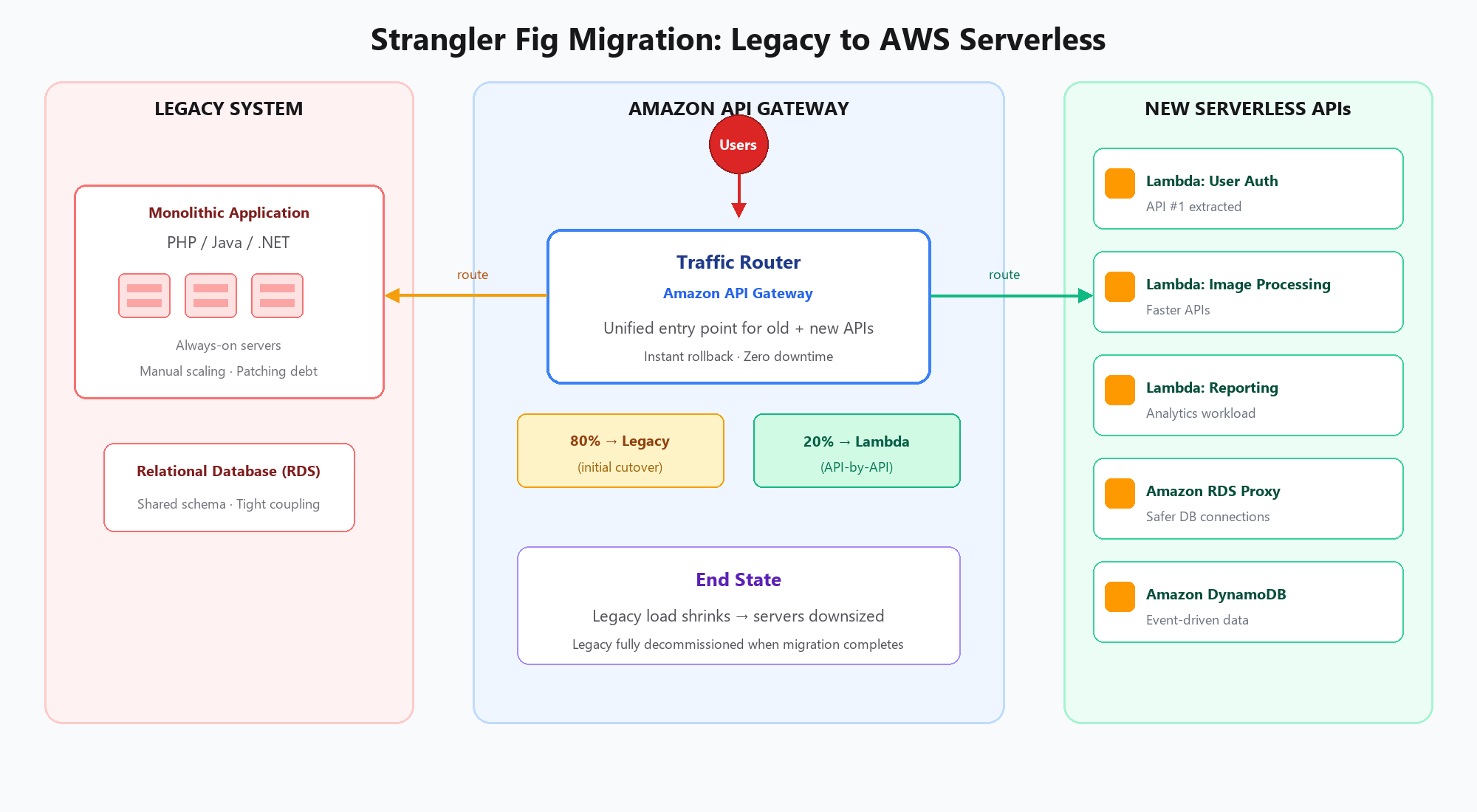
We treat migration as a surgical, incremental process, not a high-risk “big bang” rewrite. Our approach is based on the Strangler Fig Pattern, where legacy components are gradually replaced by modern serverless services.
Phase 1: The Unified Gateway
The first step is placing Amazon API Gateway in front of the existing legacy system.
Benefits
- Acts as a centralized routing layer
- Routes requests to either legacy servers or new serverless APIs
- Enables seamless coexistence of old and new systems
This creates a controlled entry point for modernization.
Phase 2: API-by-API Extraction
Instead of migrating the entire application at once, we identify:
- High-traffic endpoints
- Business-critical APIs
- Bottlenecks causing latency or cost spikes
These APIs are rewritten as event-driven AWS Lambda functions.
Key Advantage:
This allows teams to validate the value of serverless on a small, measurable scope before
touching core systems.
Phase 3: Traffic Shifting & Risk Mitigation
Using AWS routing and deployment strategies, we gradually shift traffic to the new Lambda-based APIs.
Risk Controls
- Percentage-based traffic routing
- Real-time monitoring and alerts
- Instant rollback to legacy servers if issues arise
This guarantees zero downtime during migration.
Phase 4: Infrastructure Decommissioning
As more APIs are migrated, the load on legacy servers drops.
Immediate Benefits
- Gradual downsizing of server fleets
- Early capture of cost savings
- Reduced operational complexity
Clients start saving money before the migration is fully complete.
The Performance Transformation
| Feature | Legacy Server-Based | AWS Serverless (Target State) |
|---|---|---|
| Compute Type | Virtual Machines (EC2) | Event-Driven (Lambda) |
| Scaling | Manual / Auto Scaling Groups | Instant & Automatic |
| Maintenance | OS, Runtime, Security Patches | Fully AWS Managed |
| Cost Model | Pay for Provisioned Capacity | Pay-per-Request |
| Deployment | Monolithic Releases | Granular Microservices |
Case Study Results: Real-World Impact
In a recent high-concurrency application migration, this approach delivered measurable results.
Key Outcomes
- Enhanced Performance: Reduced response times by eliminating server-side bottlenecks
- Cost Optimization: Significant reduction in monthly infrastructure spend through server downsizing
- Improved Reliability: Automatic scaling handled 10× traffic spikes with no manual intervention
Best Practices for Serverless Migration
If you are planning a similar transition, these lessons are critical:
- Migrate Incrementally: Avoid “big bang” rewrites and reduce risk with API-by-API extraction
- Measure Everything: Track latency, error rates, and cost per request, and let data guide migration priorities
- Design for Reversibility: Always keep rollback paths during early phases
Conclusion: Future-Proof Your Business
Serverless is more than a technology choice - it’s a business strategy. By eliminating infrastructure overhead and embracing event-driven design, teams can focus on delivering value instead of managing servers.
Our proven, incremental migration approach ensures that enterprises modernize safely, reduce costs early, and build platforms ready for future growth - fully aligned with AWS best practices.
Ready to Transform Your Business?
Let's discuss how our AI and software solutions can drive your success.