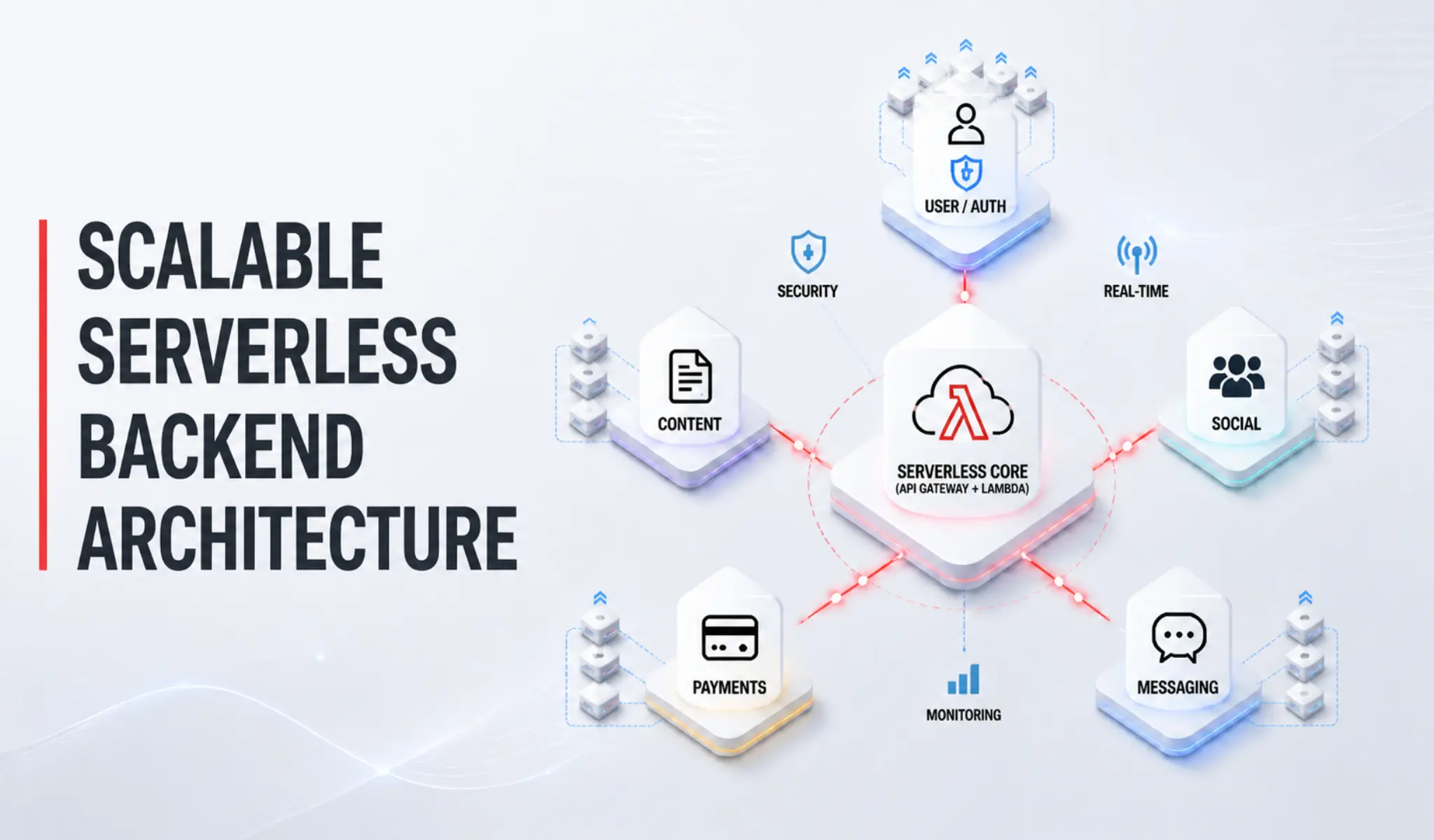
Building a Scalable, Domain-Driven Serverless Backend on AWS
Serverless, domain-driven backend rebuild for social platforms with security-first design
Introduction
In the modern digital landscape, the ability to scale instantly while maintaining strong security and cost efficiency is no longer optional - it is a requirement. As our social media platform grew, the limitations of a traditional backend architecture became increasingly visible.
This case study explores how we re-engineered a complex social media backend into a scalable, event-driven serverless architecture using AWS Lambda, API Gateway, and AWS CDK. The result is a system that scales seamlessly, reduces operational overhead, and enables teams to ship features faster and safer.
The Challenge: Overcoming Infrastructure Bottlenecks
Rapid growth introduced a set of challenges that our existing infrastructure was not designed to handle.
Key Challenges
- Unpredictable Traffic: Social media usage spikes are volatile and require instant scaling from zero to thousands of concurrent users
- Operational Overhead: Server provisioning, patching, and scaling reduced development focus
- Data Complexity: Real-time interactions required NoSQL speed, while financial and user data required strong relational guarantees
- Security at Scale: Managing hundreds of secrets across Dev, Staging, and Production while protecting sensitive user and payment data
The Strategy: Domain-Driven Serverless
To address these issues, we moved away from a monolithic architecture toward a Domain-Driven Design (DDD) approach combined with serverless infrastructure.
Each business domain was isolated into its own infrastructure stack, ensuring that changes in one area would not impact others.
Architectural Blueprint
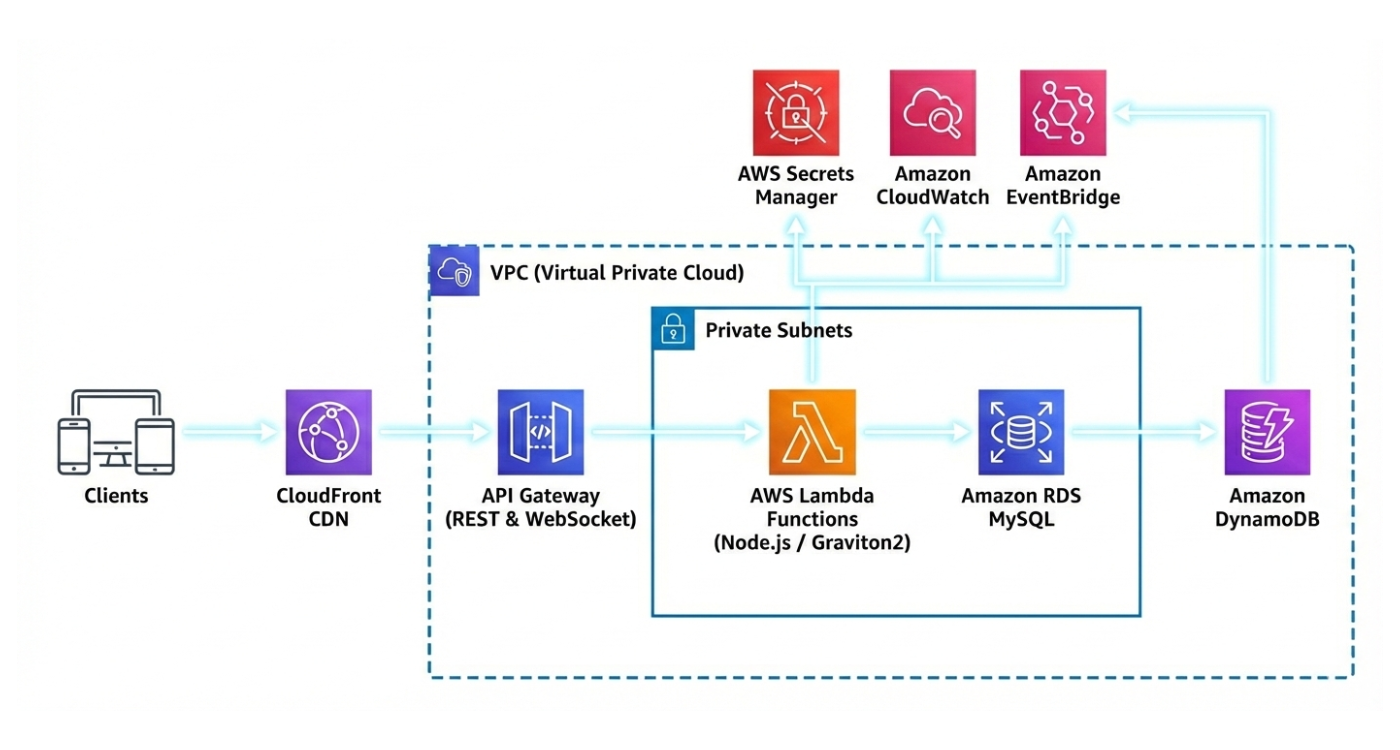
We used AWS CDK (Cloud Development Kit) to define all infrastructure as code. This enabled version control, repeatable deployments, and safe evolution of the platform.
| Domain | Key Responsibilities |
|---|---|
| Auth & User | Identity management, authentication, profile security |
| Content | Feeds, stories, comments, and content delivery |
| Social | Notifications, reactions, group interactions |
| Monetization | Payments, subscriptions, and ad integrations |
| Communication | WebSocket-based real-time messaging |
This domain isolation allowed teams to work independently and deploy safely.
Technical Deep Dive: Key Improvements
Optimized Compute with AWS Lambda
We didn’t just adopt Lambda - we optimized it for performance and cost.
- Graviton2 (ARM64): Migrated to ARM-based Lambdas and achieved ~20% better price-performance
- Cold Start Mitigation: Used EventBridge-based warm-up cycles to keep critical endpoints responsive
- Smart Memory Allocation: Standardized on 1024MB memory to balance execution speed with cost efficiency
A Dual-Database Powerhouse
A single database could not satisfy all requirements, so we implemented a hybrid data strategy.
- Amazon RDS (MySQL): ACID-compliant data for user accounts, billing, and financial transactions
- Amazon DynamoDB: Sub-millisecond latency for WebSocket connection tracking and real-time engagement data
This combination delivered both consistency and speed where needed.
Security First: Zero Hardcoded Secrets
Security was treated as a foundational concern, not an afterthought.
- AWS Secrets Manager: Centralized secrets for Stripe, JWT, FCM, and internal APIs with no secrets stored in code or environment files
- VPC Isolation: All Lambda functions and databases run in private subnets with no direct public internet exposure
- Least Privilege IAM: Each Lambda function granted only required permissions, reducing blast radius in case of compromise
The Outcome: Measurable Success
Performance & Scalability
- Automatic scaling from 10 to 10,000+ users
- Consistent response times under load
- DynamoDB delivers sub-millisecond latency for hot paths
Cost Efficiency
- Eliminated idle server costs with pay-per-use pricing
- ARM64 Lambdas reduced compute spend further
- Improved throughput with lower operational cost
Enhanced Security
- Centralized secrets and full auditability
- Reduced attack surface through VPC isolation
- End-to-end observability via CloudWatch and Datadog
Development Velocity
- Domain-driven stacks enable parallel team workflows
- Independent deployments reduce risk
- Faster feature delivery and safer releases
Best Practices for Your Migration
If you are planning a similar migration, these lessons proved critical:
- Automate Everything: Use AWS CDK or Terraform and avoid repeated manual console actions
- Monitor Early: Implement structured logging and tracing from day one; tools like Datadog or AWS X-Ray pay off quickly
- Optimize for the Runtime: Use modern runtimes (Node.js 22+) and apply connection pooling to protect databases
Conclusion
Building a scalable backend is not just about choosing modern tools - it’s about organizing them in a way that supports long-term growth. By combining serverless compute, Domain-Driven Design, and security-first principles, we built a backend that is resilient, cost-efficient, and ready for the future of social platforms.
This architecture empowers teams to move fast, scale confidently, and operate securely - no matter how unpredictable growth becomes.
Ready to Transform Your Business?
Let's discuss how our AI and software solutions can drive your success.