
CI/CD Pipeline Integration for Reliable Software Delivery
Automated CI/CD with testing, security gates, and repeatable releases across environments
Introduction
Modern software development demands speed, reliability, and consistency. As systems grow in scale and complexity, manual build and deployment processes quickly become error-prone and unsustainable.
Continuous Integration and Continuous Delivery (CI/CD) pipelines form the backbone of high-performing engineering teams by automating builds, testing, security checks, and deployments. At QrioMatrix, we design and implement robust CI/CD pipelines that enable teams to deliver features faster, reduce operational risk, and maintain high software quality across environments.
The Challenge
As applications expand across frontend, backend, APIs, databases, and cloud infrastructure, delivery complexity increases significantly. Without automation, teams face slow releases, inconsistent environments, and higher failure rates.
Key Requirements
- Enforce engineering standards automatically
- Detect defects early in the development lifecycle
- Reduce deployment risk through repeatable automation
- Support frequent, small, reversible releases
- Maintain confidence and velocity across teams
Understanding CI/CD
What is Continuous Integration (CI)?
Continuous Integration is the practice of frequently integrating code changes into a shared repository, with automated builds and tests validating every change.
What is Continuous Delivery (CD)?
Continuous Delivery ensures that validated code is always in a deployable state, allowing safe and consistent releases to production.
When deployments are fully automated without manual intervention, this is referred to as Continuous Deployment.
Benefits of CI/CD
Together, CI/CD enables:
- Faster feature delivery
- Early defect detection
- Reduced manual errors
- Predictable and repeatable deployments
Our CI/CD Design Principles
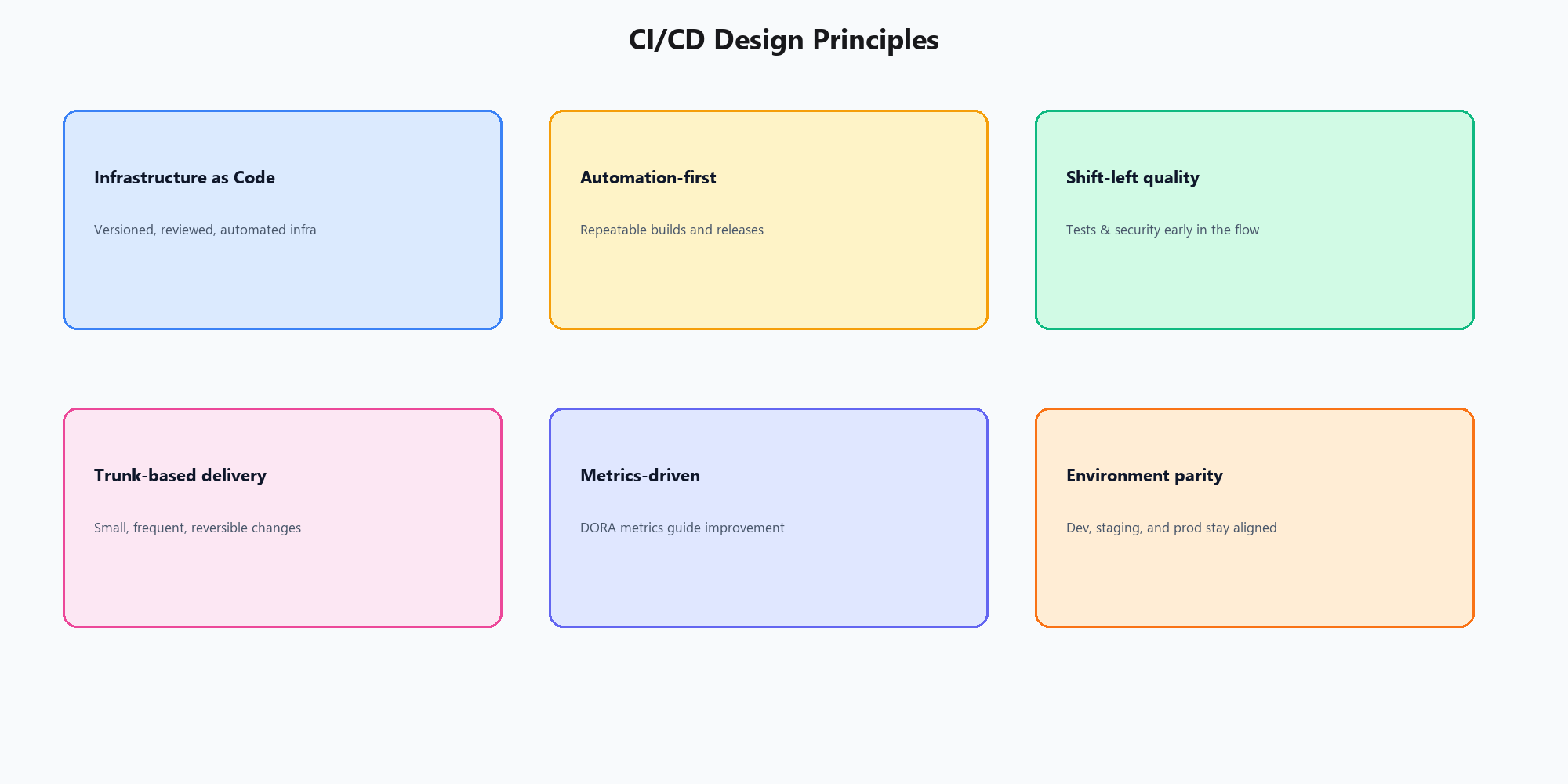
Our CI/CD architectures are built on a set of core principles that ensure long-term scalability and maintainability.
Core Principles
- Infrastructure as Code (IaC)
- Automation-first mindset
- Shift-left testing and security
- Scalable trunk-based development
- Metrics-driven delivery
- Environment parity across stages
These principles allow pipelines to evolve alongside product and organizational growth.
High-Level CI/CD Architecture
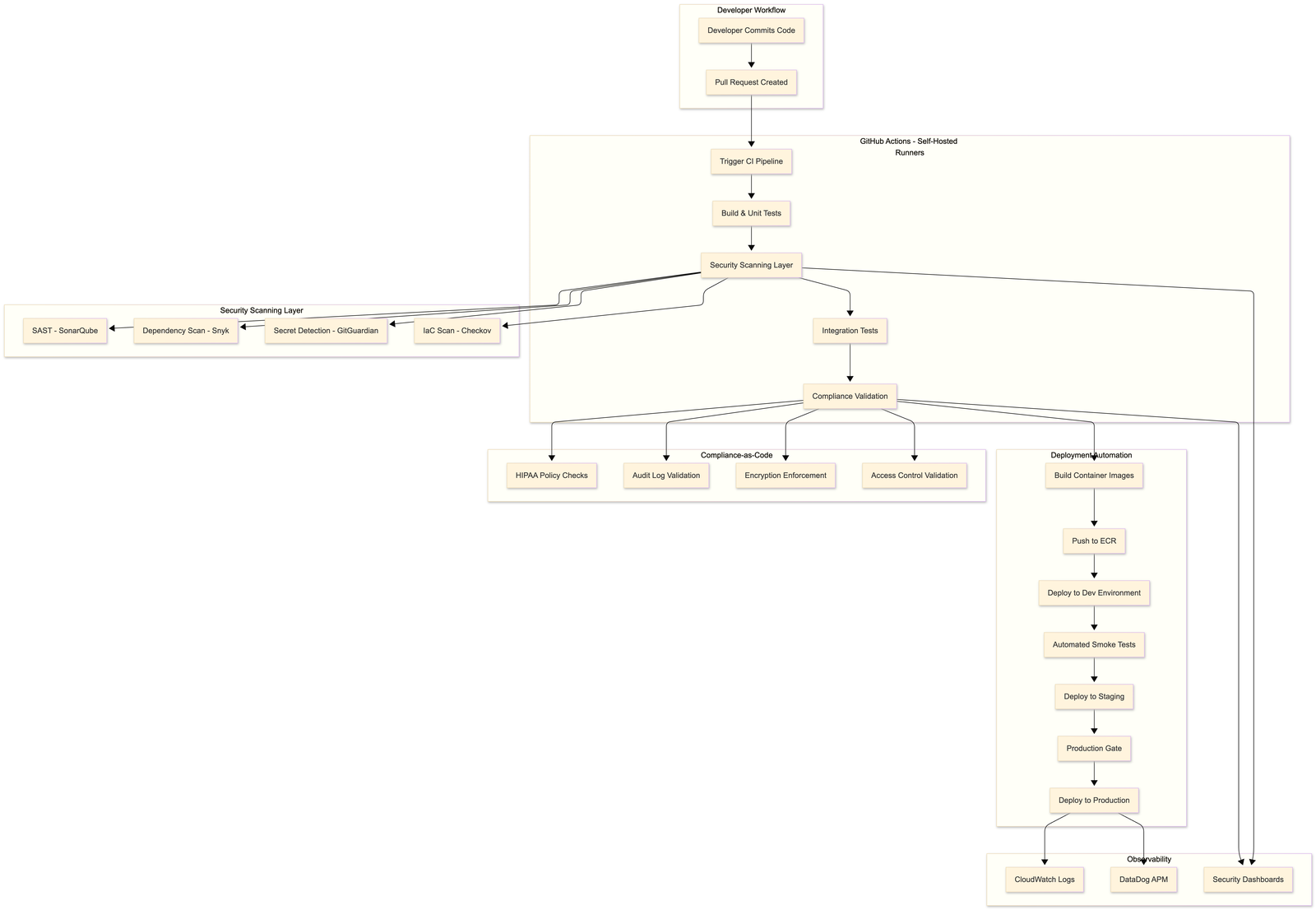
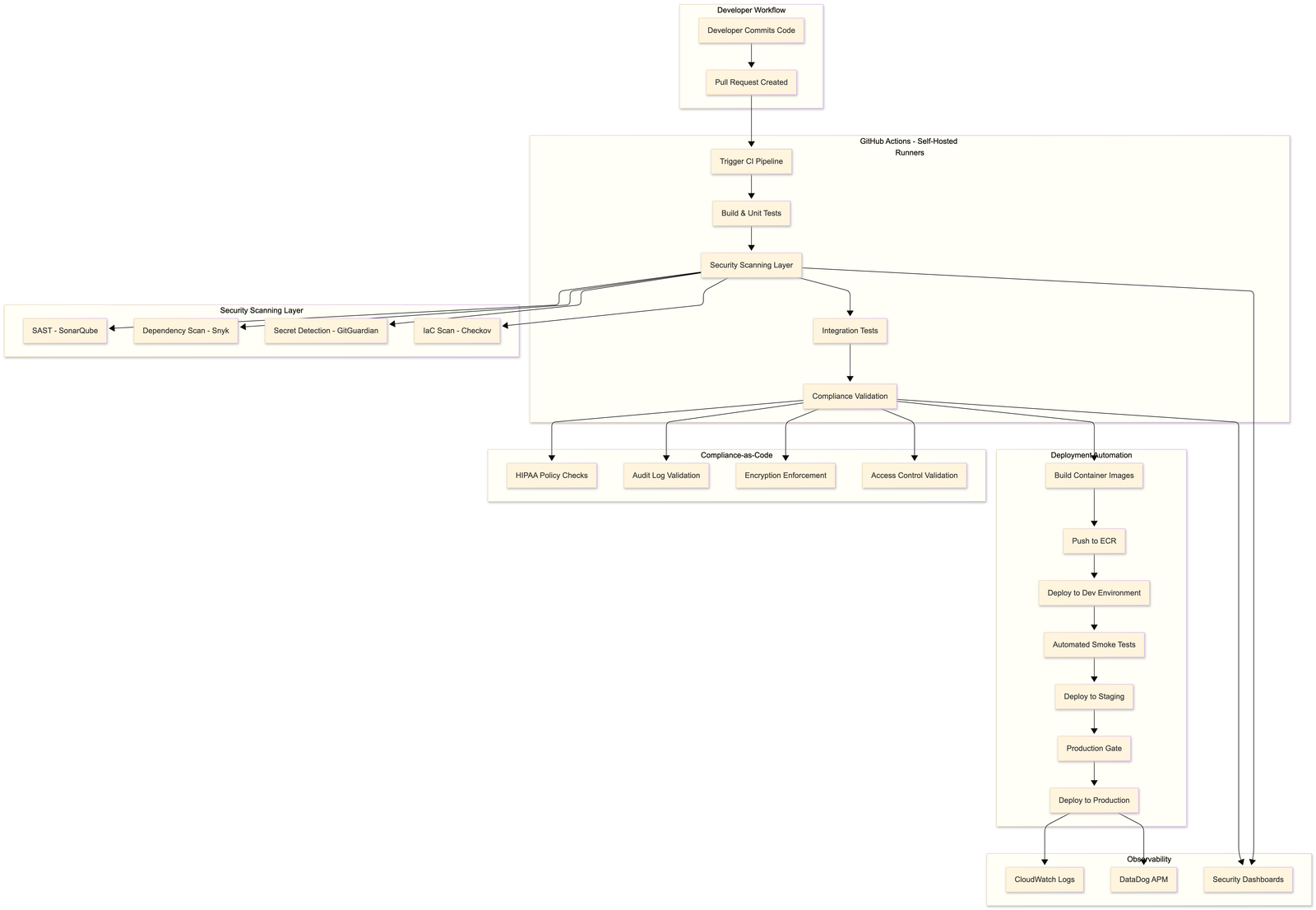
Each repository is supported by its own CI/CD pipeline, built using shared, reusable templates. This approach ensures consistency across projects while allowing flexibility for project-specific needs.
Infrastructure as Code (IaC)
Infrastructure is treated the same as application code - versioned, reviewed, and deployed automatically.
Common Practices
- AWS CDK for application-level infrastructure
- Environment and policy configuration managed through code
- Automated provisioning and updates
This approach ensures repeatable environments and eliminates configuration drift.
Technology Stack Overview
Source Control & Pipelines
- Git-based source control
- Scaled trunk-based development
- Pipeline automation using modern CI engines
Build & Runtime
- JavaScript / TypeScript (Frontend & Backend)
- Node.js
- Legacy stacks supported where required
Shift-Left Testing Strategy
Testing is embedded early in the pipeline to detect issues as soon as possible.

Testing Layers
- Unit Testing: Fast validation of business logic
- Integration Testing: API and service interaction validation
- End-to-End (E2E) Testing: UI and user journey verification
- Performance & Load Testing: Scalability validation
- Resilience & Chaos Testing: Future-ready reliability validation
Code Quality & Security Gates
Every change passes through automated quality and security checks before progressing.
Quality Controls
- Static code analysis
- Linting and formatting enforcement
- Code coverage thresholds (e.g., 60%+ minimum)
- Maintainability and complexity checks
Security Controls
- Dependency vulnerability scanning
- Secure secrets handling
- Policy enforcement through automation
These gates ensure only secure, high-quality code reaches production.
Secrets & Configuration Management
Sensitive and non-sensitive configuration data are managed securely and independently.
Best Practices
- Secrets stored in dedicated secrets management services
- Environment configuration handled via parameter stores
- No secrets committed to source control
- Environment-specific values injected at deployment time
CI/CD Pipeline Workflow
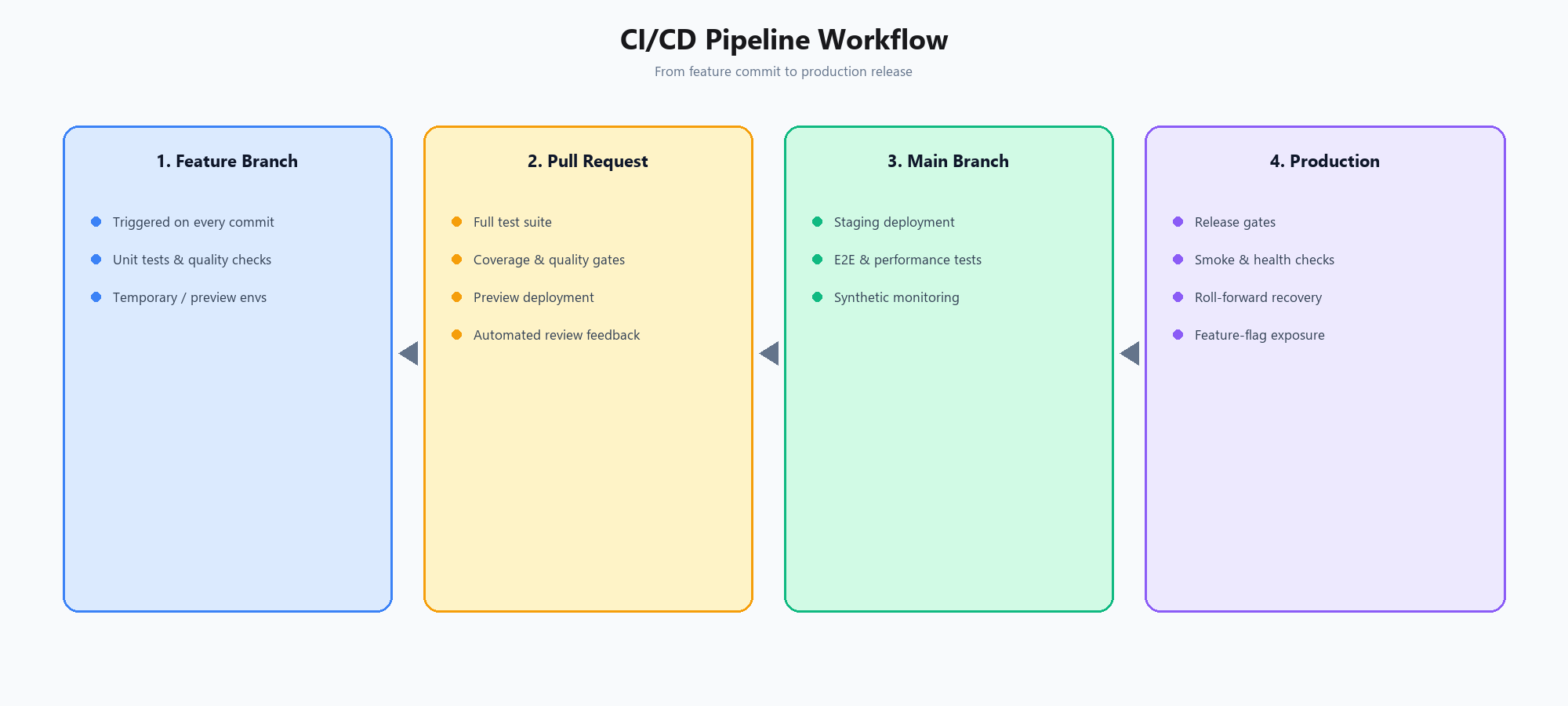
1. Feature Branch Stage
- Triggered on every commit
- Unit tests and quality checks
- Deployment to temporary development environments
2. Pull Request Stage
- Full test suite execution
- Code quality and coverage validation
- Preview environment deployment
- Automated notifications and feedback
3. Main Branch Stage
- Deployment to staging environments
- End-to-end and performance testing
- Synthetic monitoring initiation
4. Production Release
- Manual or automated release gates
- Smoke tests and health checks
- Roll-forward recovery strategy
- Feature flags control user exposure
Feature Flags & Progressive Delivery
Feature flags enable teams to:
- Release features safely without full exposure
- Perform gradual rollouts
- Instantly disable problematic features
- Separate deployment from feature release
This approach significantly reduces production risk.
Automated & Semi-Automated Gates
Automated Gates
- Build success
- Test success
- Coverage thresholds
- Security validation
- Performance benchmarks
Semi-Automated Gates
- Manual approvals for critical environments
- QA or business validation where required
- Progressive automation based on maturity
Deployment Targets
Our CI/CD pipelines support multiple deployment models:
- Cloud-native (serverless, containers, virtual machines)
- Hybrid and on-prem environments
- Multi-account and multi-region architectures
This flexibility allows pipelines to scale with business needs.
Results & Impact

Delivery Metrics
- Deployment frequency
- Lead time for changes
- Mean time to recovery (MTTR)
- Change failure rate
- Defect volume
- Mean time to detection
Metrics-driven pipelines enable continuous improvement and operational visibility.
Reusable CI/CD Pipeline Templates
Reusable pipeline templates:
- Reduce duplication
- Improve consistency
- Accelerate onboarding
- Simplify maintenance
New projects can be onboarded rapidly by extending proven pipeline foundations.
Conclusion
CI/CD is not just a tooling choice - it is a delivery culture. When designed correctly, it becomes a strategic advantage that enables organizations to innovate faster while maintaining stability and trust.
At QrioMatrix, we help teams design, implement, and evolve CI/CD pipelines that align with modern cloud-native architectures and long-term business goals.
Ready to Transform Your Business?
Let's discuss how our AI and software solutions can drive your success.