Multi-Streaming: Expanding Your Streaming Presence
Multistreaming refers to the practice of simultaneously streaming live video content to multiple platforms. With multistreaming, you can broadcast your content to popular platforms such as Facebook, YouTube, Twitch, and more, reaching a wider audience and increasing your chances of engagement and viewership. Streameg is a powerful tool that simplifies the multistreaming process, enabling you to connect and stream to multiple platforms at once effortlessly. This section delves into the concept of multistreaming and its significance in expanding your streaming reach
Written by Sehani Chathurangi
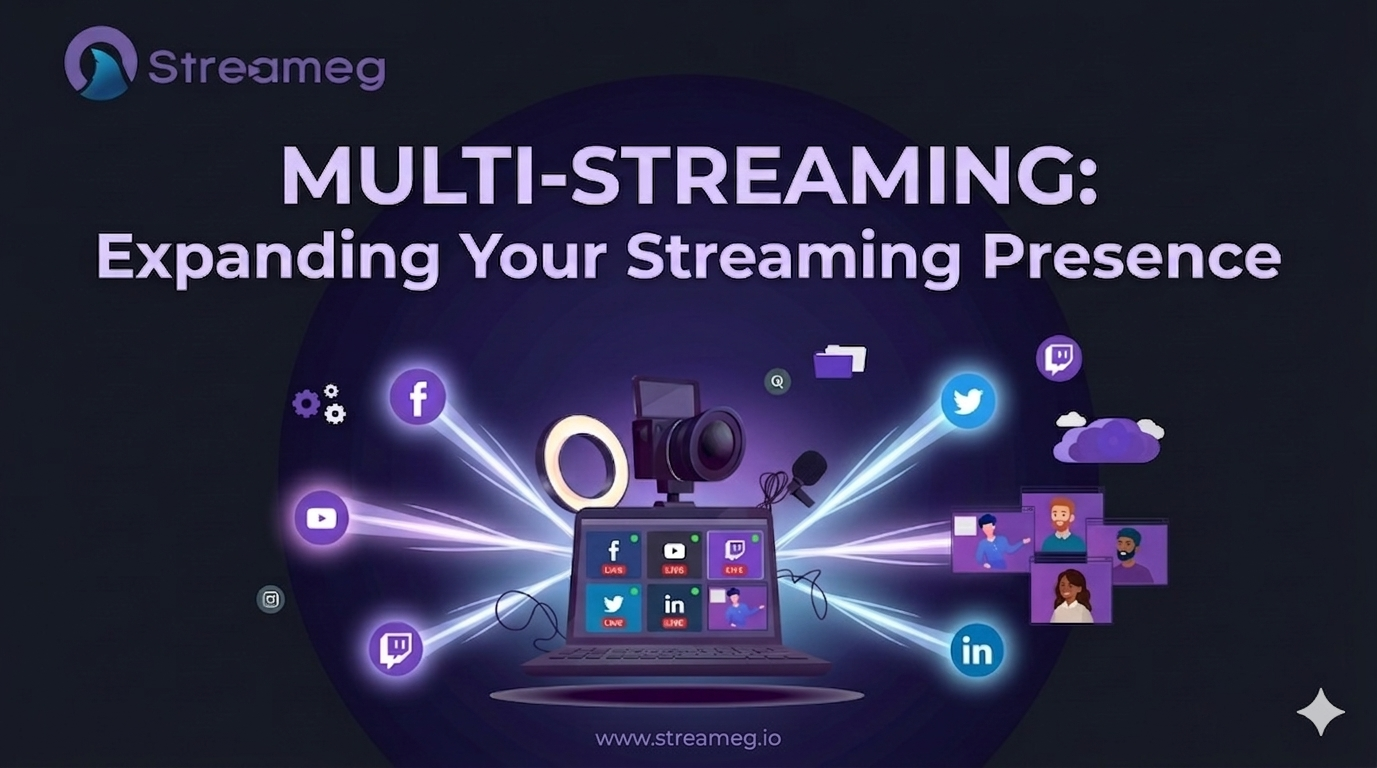
Multi-Streaming: Expanding Your Streaming Presence
1. What is multistreaming?
Multistreaming refers to the practice of simultaneously streaming live video content to multiple platforms. With multistreaming, you can broadcast your content to popular platforms such as Facebook, YouTube, Twitch, and more, reaching a wider audience and increasing your chances of engagement and viewership. Streameg is a powerful tool that simplifies the multistreaming process, enabling you to connect and stream to multiple platforms at once effortlessly. This section delves into the concept of multistreaming and its significance in expanding your streaming reach.
Multistreaming has emerged as a powerful tool for content creators to expand their streaming presence across various platforms like Facebook, YouTube, Twitch, and more. With just a few clicks, you can easily reach a larger audience and maximize your exposure. In this blog, we will explore the benefits and best practices of multistreaming and introduce you to Streameg, our simple and efficient solution for multistreaming.
1.1 The power of multistreaming
Multistreaming boosts the reach and engagement of your content by allowing you to broadcast to multiple platforms simultaneously. By broadcasting your streams simultaneously on multiple platforms, you can tap into different audiences and capture the attention of viewers who might be active on one platform but not on others. This not only expands your potential audience but also enhances your chances of connecting with individuals who resonate with your content and become loyal followers or customers.
1.2 Streameg: A simple solution for multistreaming
Streameg is the ultimate solution for multistreaming. With its user-friendly interface and seamless integration with popular platforms, Streameg simplifies the process of streaming on multiple channels. Whether you are a seasoned streamer or just starting out, Streameg provides you with a streamlined experience, allowing you to effortlessly extend your streaming presence across Facebook, YouTube, Twitch, and more. Say goodbye to the hassle of managing multiple streaming setups and let Streameg do the work for you.
2. Benefits of multistreaming
Multistreaming offers several advantages that can greatly benefit individuals or businesses. By broadcasting content simultaneously to multiple platforms or channels, the reach and exposure of the content can be significantly expanded. This means that more people have the opportunity to discover and engage with the content, leading to increased visibility, audience growth, and potentially higher engagement levels. Additionally, multistreaming allows for diversification of audience base, as different platforms may attract varied demographics. Furthermore, it provides the opportunity to repurpose content across multiple channels, maximizing its value and extending its lifespan. Overall, the benefits of multistreaming include increased reach,an expanded audience base, and enhanced content visibility.
2.1 Increased reach and audience engagement
Multistreaming offers numerous benefits when it comes to increasing reach and audience engagement. By broadcasting content on multiple platforms simultaneously, creators can tap into a wider audience base and extend their reach beyond a single platform. This helps you reach viewers who might not be active on one platform but are engaged on others. Additionally, multistreaming allows for diversification of content, tailoring it to fit different platform requirements and audience preferences. This versatility not only attracts a larger audience but also enhances engagement as viewers have more options to interact with the content they find most appealing.
2.1.1 Expanding the audience base
Expanding the audience is a key advantage of multistreaming. By broadcasting content on multiple platforms simultaneously, creators can tap into the user bases of each platform and reach a wider range of viewers. Each platform attracts a unique set of users with different preferences and interests. By making content available on multiple platforms, creators can attract new viewers from diverse backgrounds, increasing their overall audience base. This expanded audience base not only offers the potential for increased viewership but also provides opportunities for creators to connect with individuals who may not have discovered their content otherwise, fostering growth and discoverability.
2.1.2 Enhancing viewer interaction
Multistreaming has the ability to enhance viewer interaction, making the viewing experience more engaging and interactive. By streaming content on multiple platforms simultaneously, creators can leverage the different features and tools each platform offers to encourage viewer engagement. For example, some platforms include live chat features that allow viewers to interact with the creator and with each other in real-time. By utilizing these features, creators can foster a sense of community and actively involve viewers in the content, leading to higher levels of engagement. Furthermore, multistreaming also opens up opportunities for creators to receive feedback, comments, and suggestions from viewers across different platforms, providing valuable insights for future content creation and improvement.
2.2 Maximizing exposure on popular platforms
Multistreaming offers the advantage of maximizing exposure by allowing content creators to reach a larger audience on popular platforms. By broadcasting simultaneously on multiple platforms such as YouTube, Twitch, and Facebook, creators can increase their chances of capturing the attention of viewers who prefer different platforms. This strategy helps you reach different audiences on each platform, expanding your overall viewership. It allows you to connect with more viewers, gain new followers, and grow your online presence.
2.2.1 Reaching potential customers on different platforms
Multistreaming allows businesses and content creators to reach potential customers on different platforms simultaneously. By broadcasting on various platforms, they can target specific user demographics and engage with audiences that prefer those platforms. This approach helps to diversify the customer base and tap into new markets, increasing the chances of attracting potential customers who may not be active on a single platform. Reaching potential customers on different platforms enables businesses and content creators to expand their reach and connect with a broader range of potential customers, leading to increased opportunities for growth and success.
2.2.2 Expanding brand awareness and recognition
Multistreaming is a powerful tool for expanding brand awareness and recognition. By broadcasting content across multiple platforms, businesses and content creators have the opportunity to increase their brand's visibility and reach. Consistent presence on multiple platforms not only helps to reinforce brand identity but also exposes the brand to diverse audiences. This expanded exposure can lead to increased brand recognition as viewers across different platforms become familiar with the brand and its content. The more visible a brand becomes, the higher the chances of attracting new customers, building trust, and fostering brand loyalty.
2.3 Saving time and effort with streamlined processes
2.3.1. Time-saving benefits
Multistreaming offers significant time-saving benefits for individuals and businesses. By simultaneously streaming content to multiple platforms, it eliminates the need to manually upload and distribute content to each platform individually. This streamlined process allows content creators to reach their target audience across various platforms with a single action, saving them valuable time that can be allocated to other important tasks. Additionally, multistreaming reduces the time spent monitoring and managing multiple streams, as everything can be consolidated into one central platform. This not only improves efficiency but also enables creators to focus on creating high-quality content rather than getting caught up in laborious distribution processes.
2.3.2 Effort reduction
Multistreaming provides several benefits, including reducing the effort needed to reach a broader audience. By simultaneously broadcasting content across multiple platforms, individuals or businesses can avoid the need to create separate streams for each platform, thus saving time and minimizing the duplication of effort. Rather than creating and managing individual streams for each platform, multistreaming allows for a streamlined process where a single stream can be broadcasted to multiple platforms at once, eliminating the need for repetitive tasks. This not only simplifies the broadcasting process but also reduces the overall effort required, allowing content creators to focus on delivering quality content and engaging with their audience.
3. Best Practices for Successful Multistreaming
3.1 Creating compelling content for different platforms
Creating compelling content for different platforms is essential for successful multistreaming. Content creators can engage viewers by understanding their target audience and tailoring content for each platform. Research audience preferences and adapt content to fit each platform’s unique features. Using formats like videos, images, and live streams, along with different styles and enhances engagement.
3.1.1 Understanding the target audience
Understanding your target audience is key to creating engaging content. Research helps you learn about their preferences, needs, and behaviors. Knowing details like age, gender, location, and interests lets you tailor your content to their expectations. Analyzing viewership data and feedback also helps you understand what interests your audience. This knowledge helps you create content that connects with viewers and builds a strong relationship.
3.1.2. Tailoring content to suit each platform
To make the most of multistreaming, it's important to customize content for each platform. Each platform has its own unique features, functionalities, and audience expectations. Content creators should consider these factors when adapting their content to fit the specific platform. For example, on video-based platforms like YouTube or Twitch, focusing on visually engaging content is vital, whereas on text-based platforms like Twitter, concise and compelling messages work better. By optimizing content for each platform creators can enhance viewer experience, increase engagement, attract a broader audience and lead to greater success in multistreaming.
3.1.3. Utilizing different formats and styles
Using different formats and styles is key to creating engaging content for multistreaming. This helps meet the diverse preferences of your audience across various platforms. For instance, videos work well on visual platforms like YouTube and Instagram, while text-based posts are more effective on platforms like Facebook or LinkedIn. Trying out different formats and styles allows content creators to offer varied and appealing content, leading to a more successful multistreaming approach.
3.2 Engaging with your audience across multiple channels
Engaging with your audience across multiple channels is essential for a successful multi-streaming strategy. By leveraging different platforms and social media channels, you can reach a wider audience and increase your visibility. To effectively engage with your audience, it is important to create compelling content, utilize interactive features, and respond to comments and questions in a timely manner.
3.2.1. Creating compelling content
Creating compelling content is key to capturing the attention of your audience across multiple channels. Understanding your target audience and customizing your content to their interests and preferences is essential. This can include creating engaging videos, sharing valuable insights or tips, and incorporating storytelling elements to make the content more relatable. Additionally, using high-quality visuals, catchy headlines, and effective calls-to-action can further enhance the appeal of your content.
3.2.2 Utilizing interactive features
Utilizing interactive features is an excellent way to keep your audience engaged and encourage active participation during your multistreaming sessions. Incorporating features such as live polls, Q&A sessions, audience contests, and interactive chat functions can make the streaming experience more interactive and enjoyable for your viewers. This not only increases their involvement but also provides valuable feedback and insights that can be used to improve future streams.
3.2.3 Responding to comments and questions
Responding to comments and questions is crucial for fostering a sense of community and building strong relationships with your audience. Whether it's addressing queries, acknowledging feedback, or simply engaging in conversation, taking the time to respond shows that you value your viewers' input and appreciate their support. Prompt and thoughtful responses can also encourage further engagement and increase the likelihood of viewers returning for future streams.
3.3 Analyzing performance and optimizing your streams
To achieve successful multistreaming, it's essential to analyze the performance of your streams. By monitoring stream performance, you can identify any bottlenecks or issues that may be affecting the quality or delivery of your streams. This involves regularly checking metrics such as bitrate, latency, and buffering to ensure optimal performance. In addition, optimizing encoding settings is essential for efficient streaming. By adjusting parameters such as resolution, frame rate, and compression, you can enhance the quality of your streams while minimizing bandwidth usage. Lastly, implementing adaptive bitrate streaming allows you to dynamically adjust the quality of your streams based on the viewer's internet connection, ensuring a smooth and uninterrupted viewing experience for your audience.
3.3.1 Monitoring Stream Performance
Monitoring stream performance is essential for successful multistreaming. It involves keeping a close eye on key metrics like bitrate, latency, and buffering. Regularly checking these metrics helps you evaluate how well your streams are performing. High bitrates can cause buffering for viewers with slower internet, while low bitrates may reduce visual quality. Latency, or the delay between capturing and displaying content, can affect real-time interactions. Identifying and addressing any performance issues promptly is crucial for delivering a smooth and enjoyable streaming experience for your audience.
3.3.2 Identifying Bottlenecks
To optimize your multistream performance, it's important to identify and address any bottlenecks. Bottlenecks can occur at various points in the streaming workflow, such as the encoding, transcoding, or delivery process. By monitoring your streams and analyzing their performance, you can pinpoint these bottlenecks and take appropriate actions. Common bottlenecks include insufficient network bandwidth, hardware limitations, or outdated software. By addressing these issues, whether it's upgrading your network infrastructure or optimizing software settings, you can improve the overall performance and stability of your streams.
3.3.3 Optimizing Encoding Settings
Optimizing encoder settings is a crucial aspect of successful multistreaming. The encoding process involves compressing and formatting video and audio data for transmission over the internet. By tweaking encoding parameters such as resolution, frame rate, and compression settings, you can strike a balance between visual quality and bandwidth efficiency. Higher resolutions and frame rates improve the viewing experience but demand more bandwidth. Compression algorithms can reduce file sizes but might introduce artifacts if overused. It’s crucial to experiment and find the best encoding settings for your content and audience.
3.3.4 Implementing Adaptive Bitrate Streaming
Implementing adaptive bitrate streaming is a recommended practice for successful multistreaming. This technique allows your streams to adapt to the viewer's internet connection, ensuring a seamless playback experience regardless of their bandwidth. Adaptive bitrate streaming works by encoding your content at multiple quality levels and dynamically adjusting the stream quality based on the viewer's network conditions. When the viewer's connection is stable, the highest available quality is delivered, providing an immersive experience. If the viewer has a stable connection, they get the highest quality. If the connection weakens, the quality lowers to prevent buffering. By implementing adaptive bitrate streaming, you can cater to a wider range of viewers and provide a consistent, high-quality streaming experience.
4. Start Multi-Streaming with Streameg
With your Streameg account ready, it’s time to set up your multi-stream. This involves entering your stream details and selecting your streaming destinations.
4.1 Enter Your Stream Details
Log in to your Streameg account and navigate to the “Schedule Live” section. Here’s how to configure your stream:
Stream Title: Enter a title for your stream that will be displayed across all platforms.
Description: Write a description that provides context and engages viewers.
Tags: Add relevant tags to help categorize your content and increase discoverability.
Date and Time: Set the scheduled date and time for your stream.
4.2 Select Live Stream Destinations
In this step, you’ll choose the platforms where you want to broadcast your stream. Streameg allows you to multi-stream to popular platforms like Facebook, YouTube, and Twitch.
Select Your Destinations: Under the “Live Stream Destinations” section, you’ll see options to add multiple platforms.
Enter Stream Keys: For each platform, you’ll need to input the Stream Key. This key, provided by the platform, links your Streameg broadcast to your account.
Facebook: Go to Facebook’s Live Producer to obtain your Stream Key.
YouTube: Access the YouTube Live Control Room to find your Stream Key.
Twitch: Retrieve your Stream Key from the Twitch dashboard under “Stream Key & Preferences.”
Save Your Settings: Enter the details and Stream Keys, then save your configuration.
After that, enter your Stream URL, Stream Key for your broadcast.
4.3 Get the Multi-Stream Embed Code
If you wish to embed your multi-stream on your website, Streameg allows you to generate an embed code that displays your broadcast across all platforms.
4.3.1 Access the Embed Tab: After setting up your multistream settings, go to the 'Embed' tab in Streameg’s dashboard.
4.3.2 Generate the Embed Code: Click “Generate Embed Code” to create a unique code that can be embedded on your website.
4.3.3 Copy the Embed Code: Copy the embed code to your clipboard for later use.
4.4 Start Your Multi-Stream
Once your multi-stream setup is complete, you’re ready to go live.
4.4.1 Go Live: Head back to the Streameg dashboard and click “Go Live.” Streameg will simultaneously broadcast your stream to all selected platforms.
4.4.2 Monitor Your Stream: Track your stream’s performance in real-time using Streameg’s dashboard.
4.5 Optimize Your Multi-Stream
Maximize the impact of your multi-stream by optimizing the experience for your audience.
4.5.1 Customize the Stream: Tailor your stream’s appearance for each platform by adjusting titles, descriptions, and other metadata directly within Streameg.
4.5.2 Engage with Your Audience: Use Streameg’s chat integration to interact with viewers across different platforms, responding to comments and questions in real time.
4.5.3 Promote Your Multi-Stream: Share your stream links to get more viewers.
4.6 Advanced Multi-Streaming Options
For those aiming to elevate their multistreaming experience, Streameg offers advanced features:
4.6.1 Analytics: Access detailed analytics to track viewership, engagement, and performance across all platforms.
4.6.2 Custom Overlays and Graphics: Add overlays and graphics that match each platform’s branding.
4.6.3 Simultaneous Chat Management: Manage chats from different platforms in a single dashboard, ensuring you stay connected with your audience everywhere.
5. Conclusion
Multistreaming is a powerful strategy for content creators and businesses to expand their reach by broadcasting live content across multiple platforms simultaneously. By leveraging platforms like Facebook, YouTube, Twitch, and more, multistreaming allows you to tap into diverse audiences, increase visibility, and engage with viewers who may be active on different platforms. This approach not only maximizes exposure but also simplifies the process of reaching a wider audience without the need to manage multiple streams individually. Streameg further streamlines this process, making it easier to extend your streaming presence and build a broader, more engaged community.