Best Practices in Partition Key Design for DynamoDB
Amazon DynamoDB is a fully managed NoSQL database that provides high availability and scalability. One of the fundamental elements of DynamoDB’s architecture is the partition key, which plays a pivotal role in data distribution, performance, and scalability. A well-designed partition key can significantly improve performance and prevent potential bottlenecks. Here are the best practices and insights on partition key design for optimal DynamoDB performance.
Written by Sashika Dulaj

Best Practices in Partition Key Design for DynamoDB
Amazon DynamoDB is a fully managed NoSQL database that provides high availability and scalability. One of the fundamental elements of DynamoDB’s architecture is the partition key, which plays a pivotal role in data distribution, performance, and scalability. A well-designed partition key can significantly improve performance and prevent potential bottlenecks. Here are the best practices and insights on partition key design for optimal DynamoDB performance.

Understanding Partition Key Basics
At its core, a partition key in DynamoDB is used to determine how data is distributed across partitions. The partition key can be either simple (consisting of one attribute) or composite (a combination of the partition key and sort key). In tables with composite keys, the sort key allows data within a partition to be sorted efficiently, making retrieval operations more streamlined.
DynamoDB stores data in partitions, which are groups of items identified by partition keys. When a request is made to retrieve data associated with a specific partition key, DynamoDB can directly access the partition holding that data without scanning the entire table. Understanding Partition Key Basics is key to understanding DynamoDB’s ability to scale and perform well even as data grows.
Best Practices
Ensure Uniform Data Distribution
One of the most critical aspects of partition key design is to ensure uniform data distribution across partitions. Choosing a partition key with high cardinality, meaning a large number of distinct values, is essential to avoid “hot” partitions, where one partition receives significantly more traffic than others. A balanced distribution of data prevents bottlenecks that can occur when too many read-and-write requests are concentrated on a single partition.
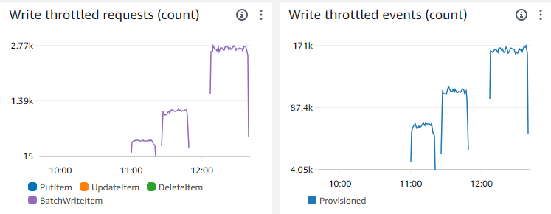
DynamoDB allocates resources like Read Capacity Units (RCUs) and Write Capacity Units (WCUs) equally across partitions in provisioned capacity mode. For example, if a table has 500 RCUs and is split into four partitions, each partition receives 125 RCUs. In a well-distributed system, this works efficiently. However, if one partition receives more traffic than others, the imbalance can cause throttling, reducing application performance.
Consider Access Patterns
The design of the partition key should also take into account the application’s access patterns. Frequently queried attributes should be considered for the partition key, ensuring that these attributes enable efficient retrieval of data without the need for full table scans. For read-heavy workloads, the partition key should optimize quick access to commonly requested items, while write-heavy workloads require partition keys that spread writes evenly across partitions. Optimize for Performance
A well-designed partition key can significantly improve performance. Each partition has throughput limits, so item size and throughput capacity must be factored into the design. Ensuring that the partition key fits within these limits is essential.
Leverage Composite Keys for Flexibility
For more complex data models, consider using composite keys. These allow for more flexible querying and data organization, especially when dealing with hierarchical data. For example, a composite key might use the partition key to group related data, while the sort key allows for finer sorting and filtering within that group. This design is especially useful when multiple entities share the same partition key, but require distinct sorting by other attributes.
Adapting to Changing Workloads
Partition key strategies must be adaptable to changing workloads over time. Even though DynamoDB automatically manages partitions and adjusts to changing traffic patterns, monitoring and adjusting the partition key strategy can improve long-term performance. Adaptive capacity helps manage uneven traffic, but the partition key should still be designed with scalability in mind.
Avoid Common Pitfalls
There are several common mistakes to avoid in partition key design. For instance, partition keys with low cardinality, meaning few distinct values, lead to uneven distribution of data, causing some partitions to become overloaded while others remain underutilized. Additionally, using timestamps as partition keys is a common mistake. While it might seem convenient, it can lead to hotspots, as newer timestamps will concentrate recent data into a single partition.
Consider Global Secondary Indexes
Global Secondary Indexes (GSIs) can be helpful for providing additional query flexibility by allowing queries that do not fit the primary key schema. When designing GSIs, careful consideration should be given to their partition key strategy as well, as they come with their own throughput and partitioning challenges. GSIs can offload query traffic from the primary partition key, helping to alleviate hotspots. By following these best practices, efficient data distribution, optimal performance, and scalability can be achieved for DynamoDB tables. The ideal partition key design will depend on specific application requirements and access patterns.
Conclusion
By understanding and effectively managing partition keys and partitioning strategies, DynamoDB’s performance can be optimized to handle various application workloads. The key lies in designing a partition key that ensures even data distribution, prevents hotspots, and leverages DynamoDB’s features like Adaptive Capacity for dynamic scalability. While DynamoDB manages much of the complexity behind the scenes, careful planning of partition key design is crucial to achieving robust, scalable, and high-performance applications.
-
Author Bio: I'm Sashika Dulaj Randeni, a full-stack software engineer. Enthusiastic about cloud computing, creative problem-solving, and always eager to explore and implement the latest advancements in the field.
-
Keywords: DynamoDB, AWS, partition key design, cloud computing, NoSQL database, performance optimization, adaptive capacity, scalable architecture, data distribution, software engineering.
-
Meta Description: Learn key strategies for effective partition key design in DynamoDB to optimize data distribution, performance, and scalability in your cloud applications.